
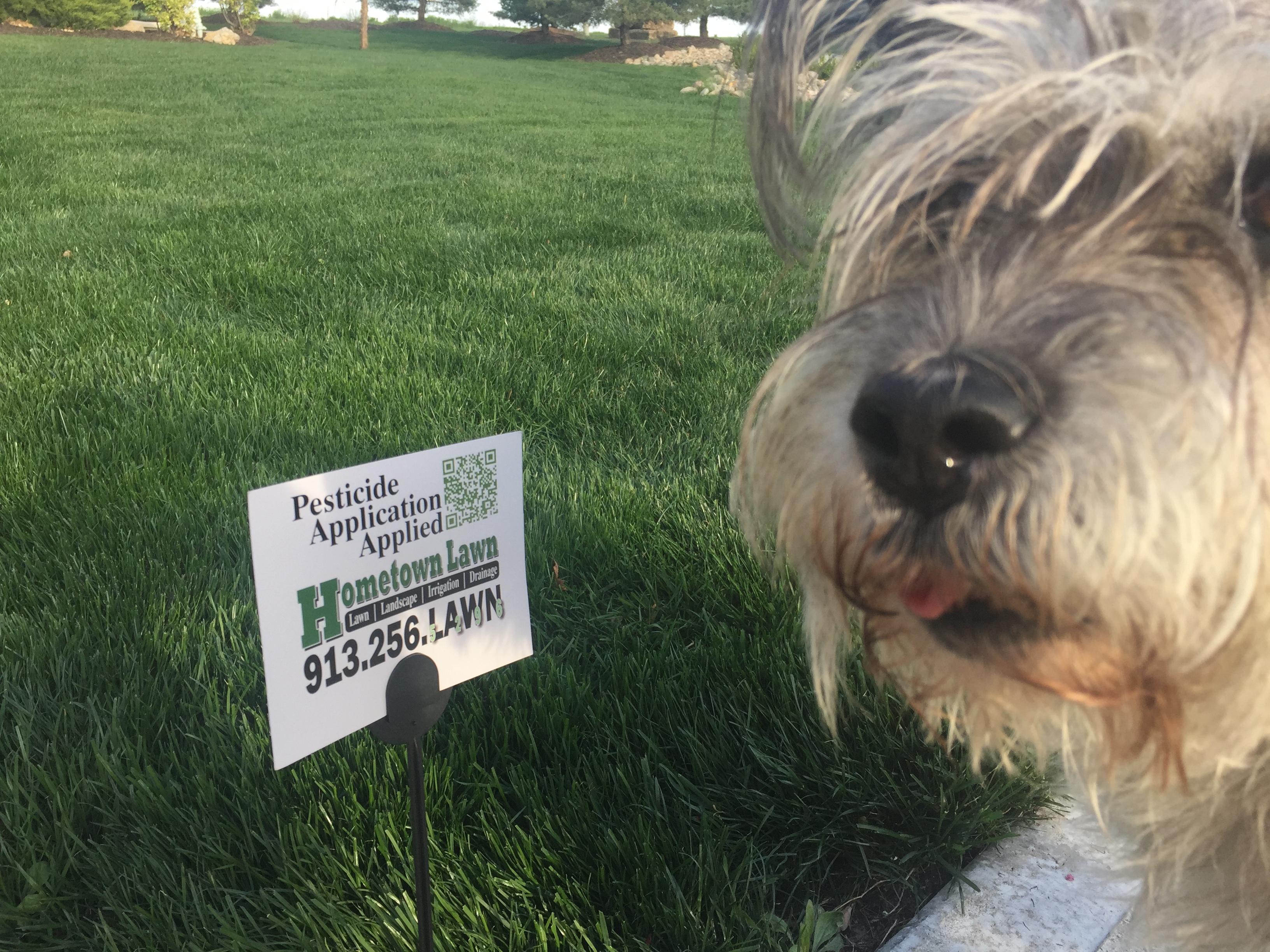
Hometown Lawn, LLC (Olathe, KS) is a full service lawn, landscape, irrigation and drainage solutions provider for commercial and residential turf licensed by the State of Kansas Department of Agriculture to legally apply pesticides. Hometown Lawn provides lawn fertilizer applications in Johnson County, Kansas. Be sure that anyone you are comparing estimates to have a license and insurance. It is required by law.
Hometown Lawn offers a full-year 7-step fertilizer program that includes grub control, or a 4-step basics plan that includes Rounds 1, 2, 5 and 7.
KDA Pesticide Business License Number: 6631
LAWN APPLICATIONS
Round 1: Fertilizer & Crabgrass Pre-emergent (2/15 – 4/15)
This is a pre-emergent with fertilizer. This is a full season application of your pre-emergent for season long protection of grassy weeds such as crabgrass, foxtail and goose grass along with broadleaf weed spray for any existing weeds.
Round 2: Broadleaf Weed Control (4/15 – 6/1)
Liquid blanket spray application to control any broadleaf weeds such as dandelions, clover, henbit, and creeping charlie.
Round 3: Spring Fertilizer (4/15 – 6/1)
Slow-Release fertilizer that delivers more nitrogen to green and strengthens the turf. This is applied the same day as round 2.
Round 4: Grub Control w/ Fertilizer (6/1 – 7/10)
This is a balanced Summer fertilizer with grub control to help the turf sustain and push through the Midwest heat and humidity along with season long weed and nutsedge control.
Round 5: Late Summer Weed Control (7/15 – 8-21)
Spot spray all Broadleaf weeds, grassy weeds, and nutsedge.
Round 6: Fall Fertilizer (8/21 – 10/15)
This Fall fertilizer is designed to help your lawn recover from Summer stress, along with your season long weed and nutsedge control.
Round 7: Winterizer (10/15 – 12/15)
This fertilizer application is the most beneficial and crucial to your lawn, this fertilizer allows the plants to store nutrients through the Winter and will provide the early green up you desire when soil temperatures start to warm the following Spring.
TREE AND SHRUB APPLICATIONS
T1-Dormant Oil (2/1 – 2/28)
This treatment controls insects and mites over the winter in the egg stage and other immature stages. This will help reduce insect and mite population for the coming season.
T2-Crabapple & Pine Protection (3/15 – 4/15)
This treatment controls early disease that appears in crabapples, Austrian and Scotch Pines. This early defense will set the table for proper disease control all season.
T2 Annual Borer Control (3/15 – 4/15) – Optional
Basal drench to control aphids, emerald ash borer, flathead borers, japanese beetles, lace bugs, leaf beetles, leaf hoppers, leaf miners, mealy bugs, psyllids, sawfly larvae
T3-New Growth Protection (4/1 – 4/30)
The New Growth Treatment will continue in the control of disease in all potentially susceptible trees and shrubs. Also, it will control early insect populations for the season.
T4-Early Season Protection (5/1 – 5/31)
The Early Season Treatment provides continued protection for insects and mites as pest pressure and populations attempt to increase. Also, it controls the disease pressure as they head into the summer months.
T5-Mid-Season Protection (6/1 – 6/30)
The Mid-Season Treatment continues controlling potentially damaging insect populations, while hitting mites hard at their highest populations of the season.
T6-Late Season Protection (7/1 – 7/30)
The Late Season Treatment controls potentially damaging insect populations that occur later in the season such as, fall webworm, tent caterpillar, and still bagworms and mites.
T7-Deep Root Fertilization (10/15 – 11/30)
This provides a balanced nutrient solution to the plants and root system, which helps plant vigor and health, and prepares it for the winter season.
Flea and Tick Program
Flea/Tick #1 (6/1 – 6/30)
Apply Flea & Tick (Crosscheck) Insecticide to turf areas.
Flea/Tick #2 (7/2 – 7/31)
Apply Flea & Tick (Crosscheck) Insecticide to turf areas.
Flea/Tick #3 (8/1 – 8/31) usually optional
Apply Flea & Tick (Crosscheck) Insecticide to turf areas.
Other Tree and Shrub Applications
Bagworms (6/1 – 7/31)
Spray insecticide to ornamental tress and shrubs to kill off bagworms.
Japanese Beetles (July)
Spray insecticide to ornamental trees and shrubs to kill off Japanese Beetles.
Perimeter Pest Control Program
Perimeter Pest Control Quarter 1 (February)
Perimeter Pest Control application to include house foundation, around doors, cracks and decks/patios. This will treat/prevent up to 21 pests. The most common pests are: Crickets, Ants, Roaches, Flies, Gnats, Moths, Silverfish, Spiders, Bees, Wasps, Centipedes, Beetles. Pillbugs, and Sowbugs.
Perimeter Pest Control Quarter 2 (May)
Perimeter Pest Control application to include house foundation, around doors, cracks and decks/patios. This will treat/prevent up to 21 pests. The most common pests are: Crickets, Ants, Roaches, Flies, Gnats, Moths, Silverfish, Spiders, Bees, Wasps, Centipedes, Beetles. Pillbugs, and Sowbugs.
Perimeter Pest Control Quarter 3 (August)
Perimeter Pest Control application to include house foundation, around doors, cracks and decks/patios. This will treat/prevent up to 21 pests. The most common pests are: Crickets, Ants, Roaches, Flies, Gnats, Moths, Silverfish, Spiders, Bees, Wasps, Centipedes, Beetles. Pillbugs, and Sowbugs.
Perimeter Pest Control Quarter 4 (November)
Perimeter Pest Control application to include house foundation, around doors, cracks and decks/patios. This will treat/prevent up to 21 pests. The most common pests are: Crickets, Ants, Roaches, Flies, Gnats, Moths, Silverfish, Spiders, Bees, Wasps, Centipedes, Beetles. Pillbugs, and Sowbugs.
Mosquito Control Program
Mosquito Perimeter Spray (April through September)
Monthly barrier spray focusing on precise application to landscape and outdoor entertaining areas. This application is applied every 3 to 4 weeks, April through September.
Termite Prevention Program
Termite Bait Station Monitoring (March through September)
First stop includes the installation of bait stations. Bimonthly bait station checks and inspections while termites are most active.